Individuality — as humans, we are gifted the ability to experience it. And yet, at a deeper level, the soul’s journey often calls us to transcend it.
While reflecting on this paradox, I arrived at an important realization: this “dropping” of individuality does not always come from awareness. Sometimes, it happens through wounding — and that is not the kind of surrender we are meant to embody.
Take the example of people-pleasing.
A people pleaser has, in many ways, already dropped their individuality — but not out of wisdom or conscious choice. It is a loss born from fear, conditioning, and the deep need for love, approval, or safety.
And that is where the real inquiry begins:
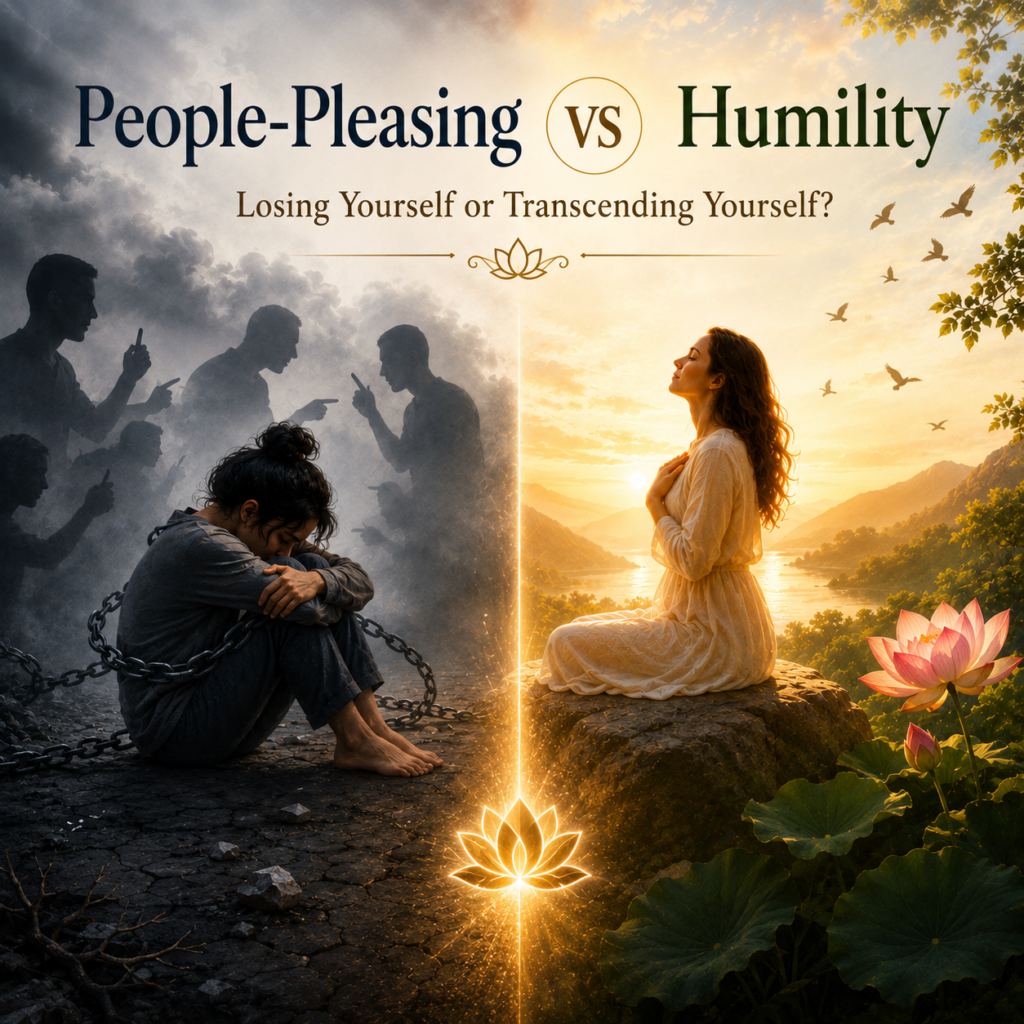
Is the self being transcended… or abandoned?
Also, I realised there is a very subtle yet profound difference between people-pleasing and humility. On the surface, both may appear similar. In both situations, a person may appear soft, accommodating, yielding, adjusting, or non-confrontational. But internally, they arise from completely different states of consciousness.
Understanding this difference is essential because many sensitive and spiritual people unknowingly confuse suppression with surrender.
Let us dig this a little deeper.
People-Pleasing: When the Self Gets Abandoned
People-pleasing is often born in childhood as a survival mechanism.
When a child repeatedly experiences criticism, rejection, punishment, emotional withdrawal, harshness, or conditional love, the child slowly learns: “My authentic self is not safe.”
To receive love, approval, appreciation, or even basic emotional safety, the child begins to adapt. They become obedient, agreeable, silent, helpful, or excessively accommodating. Gradually, a mask is created.
The individuality is not consciously transcended here; it is left behind forcefully. The child never truly gets the freedom to fully develop their authentic self because survival becomes more important than authenticity.
A new personality is taking shape — one designed to please others.
Internally, such a person may carry beliefs like:
- “If I disappoint people, I may lose love.”
- “If I say no, I may be rejected.”
- “My worth depends on being needed or appreciated.”
So the surrender happening here is not a sacred surrender.
It is a psychological submission arising from fear and emotional wounding.
Underneath people-pleasing, there is often:
- fear,
- contraction,
- anxiety,
- suppression,
- hypervigilance,
- guilt,
- or emotional exhaustion.
The person may appear kind outwardly but internally feel unseen, resentful, empty, or disconnected from themselves.
Humility: When the Ego Naturally Softens
Humility is entirely different. In humility, the individuality has already matured and integrated. A person knows themselves deeply — their strengths, wounds, limitations, emotions, truth, and essence.
And from this inner fullness, a conscious dropping of ego happens.
There is no fear or need for validation. One recognizes a larger intelligence moving through life.
A person feels “I do not need to prove myself to exist.” This is where surrender happens naturally.
A person begins to trust life, the divine, the higher self, or the unfolding intelligence of existence. There is acceptance without helplessness and softness without losing authenticity/wholeness.
This inner state — this andar ki avastha or sthiti — develops gradually through:
- Inner child wound healing work,
- awareness,
- witnessing,
- sadhana,
- and deep understanding of life processes.
In humility:
- boundaries can still exist,
- truth can still be spoken,
- individuality is not erased,
- and authenticity remains intact.
The ego is not forcibly crushed. It simply becomes transparent.
Identifying the Pattern: The Body Never Lies
But how do we truly know whether we are operating out of people-pleasing or genuine humility?
The body becomes the greatest mirror.
The mind can justify both states with beautiful spiritual language. This is why many people confuse suppression with surrender. But the body rarely lies.
When we are in people-pleasing mode, the body usually enters contraction.
Even if outwardly we appear calm, helpful, or spiritual, internally the body may experience:
- tightness in the chest/stomach
- a deep void/emptiness
- anxiety,
- shrinking,
- numbness,
- exhaustion,
- resentment,
- fear,
- or a subtle sense of abandoning oneself.
In our psyche, we know: “I am betraying my truth to stay safe.” Even if the mind says, “I’m being spiritual,” the body tells, “I’m scared.”
That is the language of wounded adaptation.
However, when we are in the avastha of humility, surrender, and inner trust, the body feels entirely different. There is expansion instead of contraction. One may still choose to bow, forgive, soften, or let go — but without inner collapse.
Instead, the body experiences:
- groundedness,
- spaciousness,
- empowerment,
- contentment,
- and inner steadiness.
There is a deep feeling of: “I am safe within myself.”
This is why embodied awareness is so important on the spiritual and healing journey.
The body continuously reflects:
- whether we are shrinking or expanding,
- suppressing ourselves or honoring ourselves,
- reacting from wounds or responding from consciousness,
- abandoning ourselves or transcending the ego.
And slowly, through awareness and sadhana, one develops the ability to pause and ask: “Does this choice make my being contract or expand?”
That question itself can become a sacred compass. Because true surrender never weakens your life force, It softens the ego, but strengthens the being.
A Personal Reflection
As I began working on myself, I realized that I had been wearing the mask of a people pleaser since early childhood. Not saying no when I wanted to, Obliging others’ wishes, Holding back my needs so I wouldn’t upset anyone, Maintaining the image of the “nice girl, overgiving.
There were so many faces to this mask. But as I continued doing the inner child work on myself, I became aware that I could address the wound, and slowly, something began to shift. Slowly, gently, I started reclaiming my authenticity as my core strength developed. I began allowing my individuality to exist — without fear, without guilt.
And in that journey, I experienced something beautiful. What emerged was a state of humility and surrender — not as an idea, but as an inner avastha, a lived experience.
I share this blog not just a concept. It is my lived truth.
And perhaps, somewhere in these words, you may find your own resonance too.
If you do… I would love to hear your journey. 🙂
Chao!