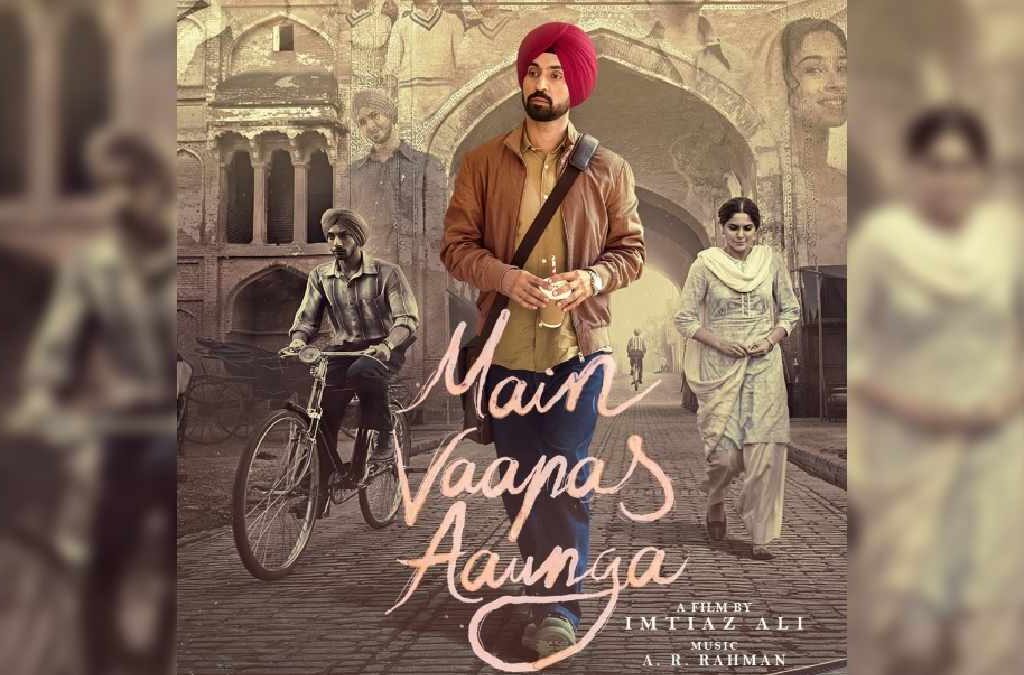
I watched Main Vaapis Aaunga twice, on two consecutive days.
(I had actually written these thoughts in my diary soon after watching it, but somehow never got around to putting them into a blog. Then, when I saw the movie available on Netflix again, I thought, “I have to share this.” So, here I am — finally putting into words what this movie left me with.)
The first day, I went with my friends; I am thankful to my friend who invited us for the same. The very next day, I went again with my 17-year-old daughter. After the movie, my daughter and I went out to eat. We sat at the dining table and started discussing the film. We talked about the characters, Partition, choices people made, pain, relationships, the questions it left behind. We were so engrossed in the conversation that we didn’t even realise when our food was over and when the bill arrived! Certain movies make you reflective, shaking something inside you, and continue to live in your mind long after the screen goes dark. For me, Main Vaapis Aaunga is one of those movies.
And what has fascinated me even more is my daughter’s response. Now, before you start imagining that my 17-year-old has suddenly become some serious student of Hindi cinema — let me clarify! She absolutely dies to watch K-dramas and horror thrillers. 🙂 . What touched me was the substance that stayed with her. It has been almost a month since we watched the movie, and she hasn’t wanted to go to the theatre for another movie. She said something like, “After watching this movie, I’ll wait for another movie that makes me feel it is worth going for…”
Isn’t that amazing coming from a 17-year-old? That, to me, is the power of cinema.
After the movie ends, something inside you becomes more awake. And Main Vaapis Aaunga did exactly that for me.
When the hunger for power forgets humanity
People were fighting to free a nation that had been enslaved for nearly 200 years. Of course, in such a massive struggle, people would think about what would work best to achieve freedom and independence. But somewhere amidst that struggle, another kind of madness took over. The madness of power, of individual interest, the madness of “How much is there in it for me?”
And I think this is where humanity can lose its way. When an ignorant sense of individual benefit hijacks the larger good, we forget our own pakness — that innate purity, that basic humanity within us.
Power hunger becomes poisonous. Fear becomes poisonous.
And when fear and power combine with blind beliefs and fanaticism, human beings can become frighteningly animalistic. That, for me, is one of the deepest tragedies of Partition.
People were divided in the name of religion. Fear was aroused. Communities that had lived together, traded together, shared lives and built ordinary everyday relationships were suddenly made to look at each other through the narrow lens of religious identity.
And the most painful irony?
The people who paid the price were often the people who had nothing to do with the power struggle. They weren’t hungry for political power, or for that matter, they weren’t fighting over land; they weren’t responsible for the decisions being made at the top. They were simply living, sharing and being part of a community.
And yet they had to bear the brunt of the madness.
Sargodha
That is what stayed with me about the people of Sargodha.
What kind of injustice must these people have experienced? Pain. Trauma. Loss. Displacement.
They were simply living their lives. Yet suddenly they had to leave homes they had built, relationships they had nurtured, places that had held their memories. They had to carry their belongings, their losses and their memories into an uncertain future.
But the heaviest thing they carried was probably their unprocessed grief!
Because what happens when pain is too big to feel? We become numb, the tears dry up, and our hearts stop protesting. We simply survive.
And perhaps that is what happened to many people who lived through Partition. Their hearts and eyes had nothing left. Only deep, deep numbness.
And perhaps that numbness helped them survive. But what helps us survive one generation can sometimes become a wound in the next. The grief that was never expressed doesn’t necessarily disappear. It can travel. Through untold stories, bone-breaking silences, through fears nobody understands, as well as behaviours that seem irrational to the next generation.
And this brings me to the part of the movie that stayed with me the most.
The grandson who couldn’t find home
There is a beautiful scene where the grandson listens to what his grandfather had written in Urdu. And as he listens, he suddenly realises something astonishing:
What his grandfather had written was almost exactly what he himself had been experiencing!
This young man cannot settle. He cannot stay with one job or in one relationship or in one place. He has a home, yet somehow he cannot feel at home. He keeps searching for home. Interestingly, there is no obvious external reason for it. He has a stable life. And yet something inside him keeps pulling him away. Until he hears his grandfather’s story. His grandfather had lived through Partition. A man who had literally been made homeless by history. And here was his grandson, decades later, unable to settle anywhere. It struck me so deeply because this is exactly the kind of possibility that makes me think about Family Constellation.
Family Constellation:
One of the principles underlying Family Constellation is that within a family system, deeply traumatic experiences that have not been fully acknowledged, grieved, or integrated can show up as patterns in later generations.
A descendant may carry something without consciously knowing whose pain it is.
We may feel:
- Why can’t I settle?
- Why do I keep repeating the same relationship pattern?
- Why do I feel like I don’t belong?
- Why do I feel guilty when my life is actually good?
- Why am I restless when there is no reason for me to be restless?
- So on and so forth…
And sometimes we keep looking only at our own individual life for the answer. Family Constellation invites us to look at the larger system.
To ask:
“Is all of this really mine?”
Because perhaps there was a grandfather who lost everything, or a grandmother who never got to grieve, or an ancestor who was displaced, or someone who was excluded, or someone whose story was never heard, or perhaps someone who died carrying an unfinished pain.
And sometimes, out of what Family Constellation calls blind love, a descendant may unconsciously remain connected to that pain. Neither do we want to suffer, nor do we consciously choose it. But somewhere deep within, there is an unconscious loyalty:
“If you couldn’t have a home, how can I comfortably have one?” or
“If you suffered, how can I be completely happy?”
And suddenly, a behaviour that seemed completely irrational begins to make sense when seen in the context of the family system. This is why that scene stayed with me.
As I write this, I can almost hear the voices of friends familiar with Family Constellation, whose own families lived through Partition, echoing in my ears. Their stories remind me that this is the reality of so many families — ancestors who carried and buried grief to survive, and descendants who may unknowingly carry what was never processed.
And perhaps this isn’t only about Partition.
How much of what we carry today may actually belong to our family system — pain, grief, fear and patterns that began before us?
That, for me, is the deeper question this movie leaves behind.
And this is where healing can begin
In Family Constellation work, we don’t try to erase history or pretend the pain didn’t happen; we don’t tell someone to “move on.”
We begin by seeing- seeing what happened, acknowledging the pain, honouring those who came before us, including those who were forgotten or excluded, giving people their rightful place in the family story.
And then, being able to say:
“And because I love you, I don’t need to live your pain for you.” Because sometimes we confuse carrying someone’s pain with loving them, but we can love our ancestors deeply without repeating their suffering. Perhaps we can honour their lives by living ours fully.
Family Constellation work helps us transform blind love into expanding love — where we can honour those who came before us without unconsciously carrying their pain. (Another Self, the Netflix series, beautifully brings many of the principles of Family Constellation to life.)
Was this intentional?
Now, I have absolutely no idea whether Imtiaz Ali consciously created the grandson’s character with this layer of intergenerational trauma in mind. Maybe it simply emerged through the story. And honestly, I find that possibility fascinating too. If I ever get an opportunity to meet him, this is one question I would definitely ask: “Did you consciously write the grandson’s inability to settle as an echo of his grandfather’s displacement during Partition?” If he did, I would acknowledge him for the depth of the writing and research. And if he didn’t, then perhaps it is an equally beautiful example of how a story can contain truths that go beyond what its creator consciously intended.
Become the Rudali
And this brings me back to where this movie took me emotionally. I cried while watching it.
Back home, as I sat reflecting on what I had experienced, for a moment, I felt as though I had become a Rudali for them. Because probably what these people needed most was not another person explaining their suffering. They needed someone to feel it with them, and to cry when their own tears had dried. Someone to sit beside the grief that had become too old and too deep to express.
We need not be the people who keep fighting about who was right or the ones who keep reopening the political arguments. But sensitive human beings who can look at what happened and say:
“I see you.” or perhaps “I remember you.” or “Your suffering mattered.” or “You deserved better.” or perhaps ALL OF THESE!
I would recommend Main Vaapis Aaunga so strongly (Now available on Netflix)
Watch it once, with your heart open. And if you find yourself crying, don’t rush to stop the tears; Pay your Rudali to those whose grief has remained unseen.
By allowing ourselves to feel their pain, we also become a little more conscious of the pain we ourselves may be carrying.
Let the movie move you, and while you are watching, you may ask yourself two very simple questions:
“How do I resonate with this story?”
“What is my family carrying that I am unknowingly carrying too?”
Because sometimes, that question is where healing begins.